

EVENTS
Some of our past events include:

Role of Standards and Standardization in the Age of AI
17 June 2025
The Architecture, Engineering, and Construction (AEC) industry is no stranger to technological advancements. From the transition of Computer-Aided Design (CAD) to Building Information Modeling (BIM), and more recently, the emergence of Digital Twins, each phase has promised transformative outcomes. Today, artificial intelligence (AI) represents the next frontier – but is it another technology hype cycle, or does it hold the potential to unlock unprecedented value for the AEC sector and deliver a sustainable built environment?
AI has the ability to not only automate tasks but also has a potential to provide predictive and prescriptive insights, enabling smarter decision-making across the project lifecycle.
The session will address key questions: How is AI fundamentally different from past innovations? What lessons can be drawn from the implementation of BIM and Digital Twins to guide AI integration? How can AI enhance human ingenuity? Which practices are imported for a transparent and trusted AI? Most importantly, how can organizations prepare themselves for this transition?
Attendees will gain insights into: The role of standards in accelerating AI’s potential in AEC; Key differences between AI and earlier technology innovations; The critical importance of openBIM standards in ensuring AI’s success; How to align AI adoption with broader organizational and industry goals.
This session is aimed to inspire participants to view AI not as a standalone innovation but as a transformative enabler within a larger ecosystem – ready to redefine the AEC industry’s sustainable future.

Enhancing Engineering with BIM - A Holistic Approach
28 May 2025
Building Information Modeling (BIM) revolutionizes engineering by integrating advanced technologies and fostering efficient asset management. It leverages cutting-edge software and IoT for precise 3D modelling and real-time monitoring, enhancing collaboration and decision-making. BIM supports preventive maintenance and lifecycle management, ensuring optimal asset performance. It also serves as an educational tool, promoting continuous learning and innovation in the industry. Embracing BIM means re-imagining workflows for greater efficiency and sustainability in construction projects.
The full benefit of BIM is only realised when we think beyond the design and construction phase of buildings and infrastructure. BIM can do so much more than clash detection and design co-ordination. Properly configured models containing structured attribute data related to the many components of buildings and infrastructure can be easily transferred across the “commissioning line” to the operations and maintenance phase. Digital models and data can be moved from the construction phase to the operations phase if the data is well structured and managed, saving a lot of time for the operations and maintenance teams. Achieving this value-add requires well thought-out workflows and particularly data transfer, this is what BIM is all about.
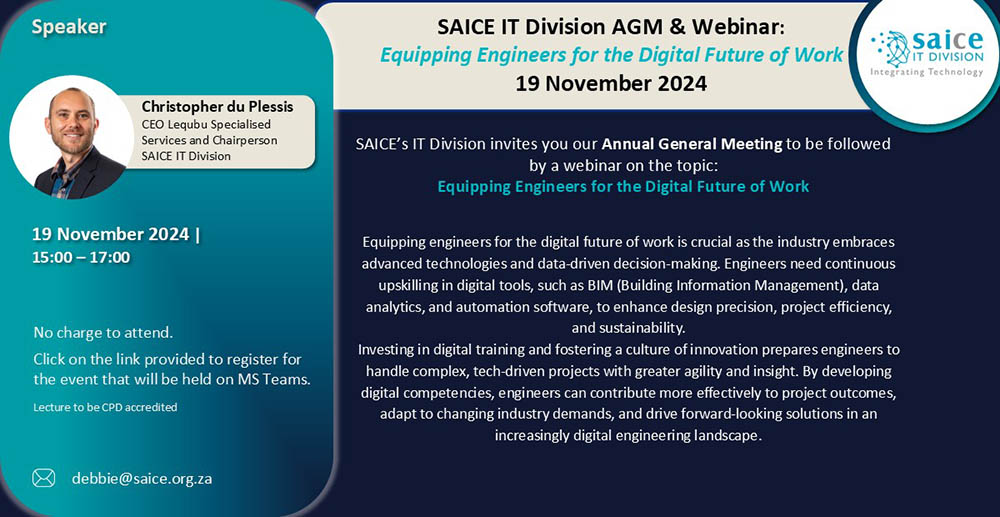
Equipping Engineers for the Digital Future of Work
19 November 2024
Equipping engineers for the digital future of work is crucial as the industry embraces advanced technologies and data-driven decision-making. Engineers need continuous upskilling in digital tools, such as BIM (Building Information Management), data analytics, and automation software, to enhance design precision, project efficiency, and sustainability.
Investing in digital training and fostering a culture of innovation prepares engineers to handle complex, tech-driven projects with greater agility and insight. By developing digital competencies, engineers can contribute more effectively to project outcomes, adapt to changing industry demands, and drive forward-looking solutions in an increasingly digital engineering landscape.
Innovative Digital Solutions for Transport Infrastructure
15 October 2024
The Western Cape road network, covering approximately 7500km of paved and 10500km of unpaved roads, along with 3000 bridges and culverts, relies on multiple legacy systems for daily management. These in-house systems handle everything from road proclamations and condition assessments to wayleave applications and as-built records. However, the technology behind these legacy systems has become outdated and incompatible with modern tech stacks, necessitating a digital transformation process.
Over the years, our business processes have evolved, but our systems have not kept pace, resulting in several challenges. The retirement of seasoned technical staff without proper knowledge transfer and a siloed approach to development have made data access extremely difficult, complicating the integration of off-the-shelf solutions due to legacy data issues. However, these challenges also present an opportunity for innovation and leveraging technological advancements. This presentation will delve into the early development stages of our latest digital solution, the km suite, an end-to-end solution for collecting, validating, and viewing transport infrastructure data.
Adoption and Implementation of BIM Enabled technologies: a Contractor’s journey
July 2024
This presentation explores adopting and implementing Building Information Modelling (BIM) enabled technologies in modern construction projects. It delves into integrating 3D modelling, 4D simulation, and reality capture, showcasing how these tools enhance project planning and execution.
The discussion will highlight the benefits of improved visualisation, streamlined workflows, and enhanced collaboration among stakeholders, ultimately leading to more efficient and effective construction processes. Emphasis is placed on real-world applications and case studies demonstrating the transformative impact of BIM-enabled technologies in the industry.
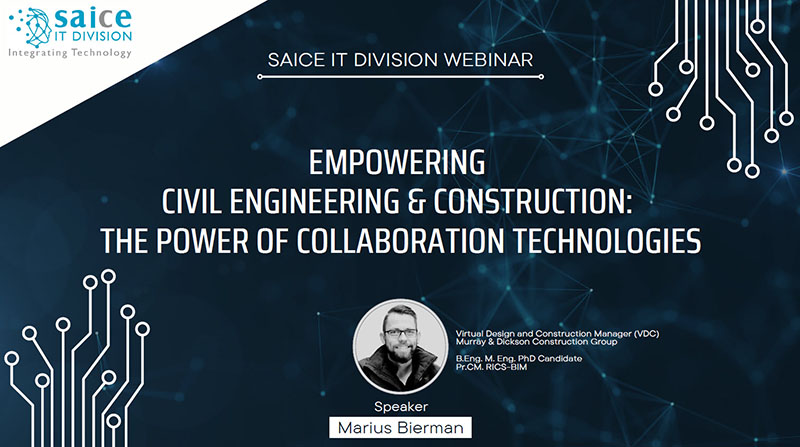
Empowering Civil Engineering & Construction – The Power of Collaboration Technologies
October 2023
The presenter Marius Bierman covers the historical perspective of the topic – where we started, including the traditional methods in civil engineering and construction, as well as limitations of older methodologies. The transition phase will cover the early signs of technological integration as well as the initial resistance and challenges. A discussion includes:
- The Rise of Collaboration Tools
- Benefits realised
- Case Study
Topics covered include:
- Building Information Modelling (BIM)
- Virtual & Augmented Reality (VR & AR)
- Drones in Construction
- Wearable Technologies
- Integrated Platforms and IoT
Digital Twins and the Engineering Transformation
August 2023
We’ve all heard about a digital twin, but what does it mean? How does one start and what is the complexity within it? In this presentation, we look at the building blocks required, maturity levels, the technology required and some approached and use cases.
AI & Automation: can it bring insights, efficiencies, and better decision-making to the utility industry?
July 2023
Mark Lee (Civil Engineer, VAPAR)
Mark has spent more than a decade as an engineer managing the asset lifecycle of pipes. He’s been involved in design and construction through to condition assessment and decommissioning, including all that occurs between. He made the move from a public utility to VAPAR after seeing the industry’s need for improved modern solutions to pipe condition assessment and the associated management of data. Mark is passionate about improving business efficiency and utilising data to drive smart decisions.
Elakkiya Ramarajan (Lead Data Scientist, VAPAR)
Elakkiya is an experienced data scientist with expertise in AI, Deep Learning, Machine Learning, and computer vision. With a master’s degree in information technology from UNSW, Sydney, and an undergraduate background in Electrical and Electronics Engineering from Anna University, Chennai, she bridges the gap between technological advancements and electrical engineering principles. She is renowned for her seamless integration of state-of-the-art AI and ML models into traditional software engineering practices. Her focused approach to solving industry problems using statistical and AI models has yielded remarkable benefits, including improved decision-making, optimized operations, enhanced accuracy, and increased efficiency. With her adeptness in leveraging AI and deep learning techniques, she empowers businesses to gain invaluable insights, streamline processes, and achieve transformative outcomes.
Katy Bevan (Programme Delivery Manager, United Utilities)
Katy is a water industry professional with 9 years of experience at United Utilities, one of the UK’s largest listed water companies. Strong background in wastewater network operations with current role as Programme Delivery Manager, within Integrated Network Delivery, overseeing the delivery of several key programmes of routine maintenance work across the region, including sewer cleaning and associated CCTV survey works, non-powered asset inspections, wet well cleansing and maintenance of customer flood mitigation. Key experience in efficiency challenges and the support of onboarding new technologies into the business, leveraging benefit and promotion of application to a wider audience.
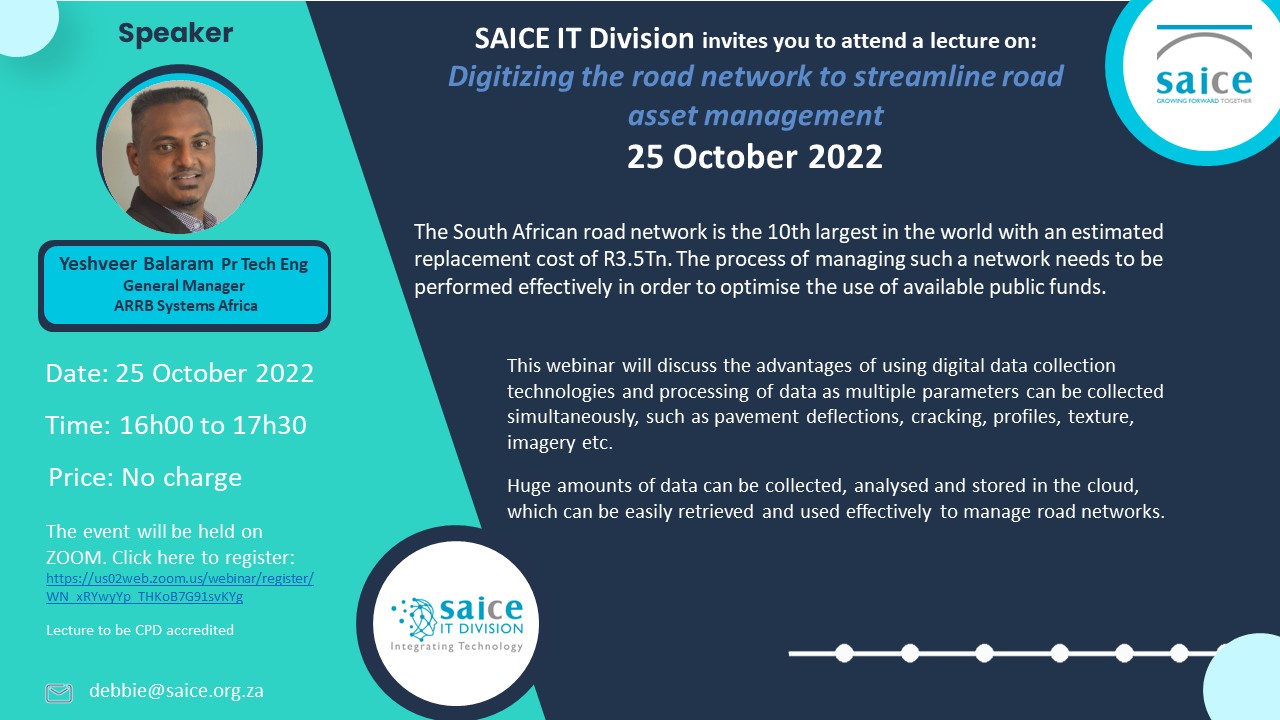
Digitizing the road network to streamline road asset management
October 2022
The South African road network is the 10th largest in the world with an estimated replacement cost of R3.5Tn. The process of managing such a network needs to be performed effectively in order to optimise the use of available public funds. This webinar will discuss the advantages of using digital data collection technologies and processing of data as multiple parameters can be collected simultaneously, such as pavement deflections, cracking, profiles, texture, imagery etc. Huge amounts of data can be collected, analysed and stored in the cloud, which can be easily retrieved and used effectively to manage road networks.

The Data Revolution – Digital Twin and Other Smart Technologies
13 July 2022
Every day we collect more data than we use, this is often referred to as information overload. Inside companies there is a new focus to extract what we need, reducing duplication, sharing intelligence and allowing data to improve the way we work and the decisions we make allowing us to facilitate change.
Connectivity is the key to the digital world, bringing the physical and digital worlds together. Allowing a change to traditional mindsets, allowing systems and processes to work together in a trusted environment. Technologies are transforming the way we design, build, maintain and manage the lifecycle of our connected ecosystems.
The presentation introduces you to the smart revolution of technologies such as digital twin, biometrics and blockchain, how they work, how they are being used and what they can offer in the future.

Cloud Collaboration for Structural Engineers
18 May 2022
This webinar was presented by the SAICE Structural Division and the SAICE IT division.
96% of all data generated during the design of a construction project goes unused in engineering and construction, according to a study done by FMI Corporation. Internationally, $280 billion is spent on rework costs annually strictly due to poor project communication.
This webinar introduces cloud technology for structural engineers and illustrates how it makes the work of the engineer, and other project stakeholders, more effective and productive simply by improving the way in which we communicate.
Construction of Polihali Dam Western Access Road utilising digital technology
24 June 2021
The Lesotho Highlands Water Project (LHWP) comprises a new 55km Polihali Western Access Road (PWAR) and the rehabilitation of a 96km Northern Access Road (NAR).
The PWAR is split into two sections, East and West. The road ties into the existing NAR, which provides access to the Katse Dam basin between Leribe and Katse village through Pitseng. The two roads join at Ha Seshote and provide a further link to the proposed Polihali Dam basin for a tunnel-boring machine (TBM) and transporting other construction equipment and materials.
To streamline construction activities and improve communication with designers, the site team have implemented various digital tools.
The implementation of these tools are show-cased and the advantages and disadvantages are discussed.
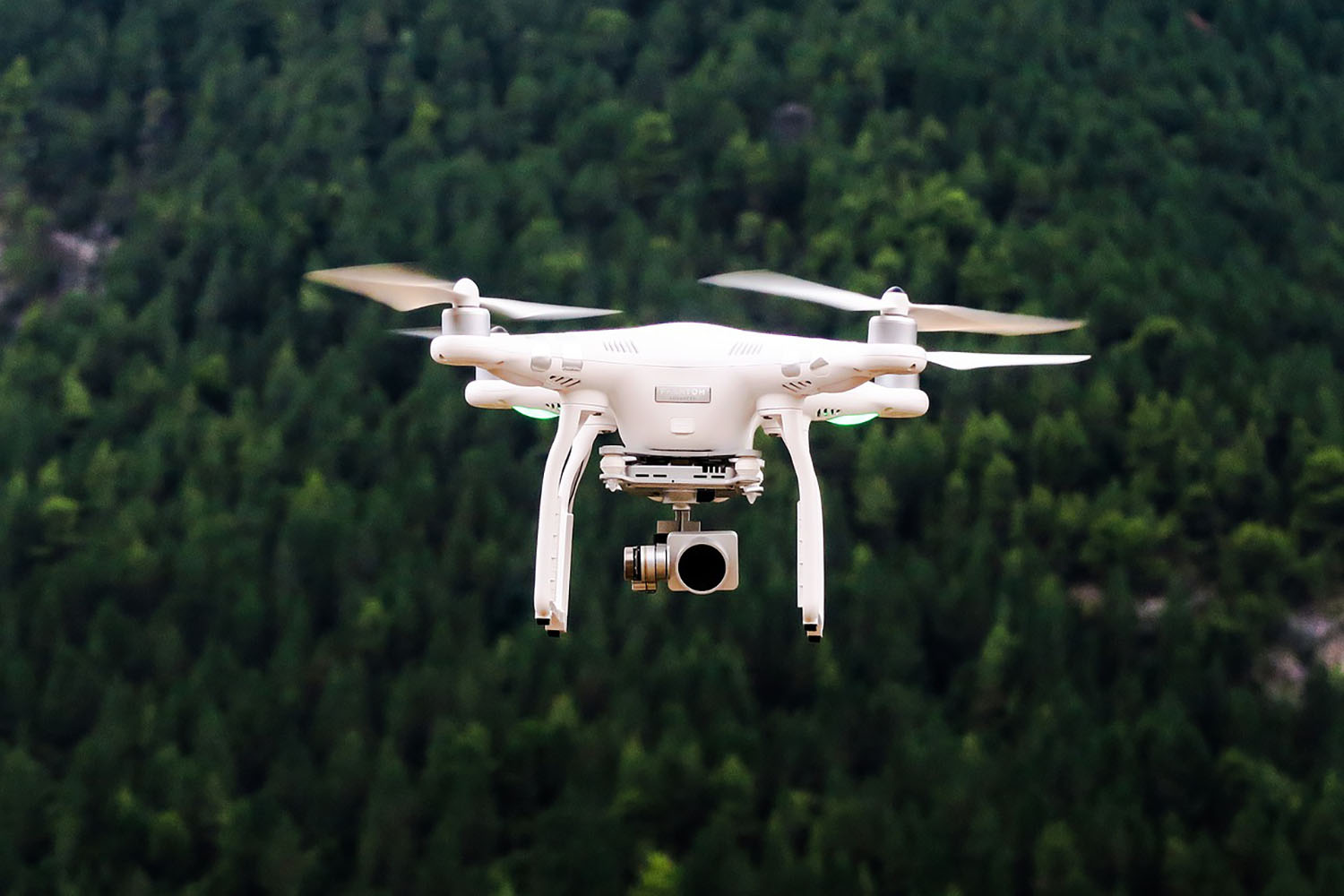
Post COVID, why Drones, Digitization, and Artificial Intelligence are needed now more than ever.
16 July 2020
A panel discussion with experts in the field of digitization technology and hear what the benefits are of these ground-breaking solutions.
- Aurecon share their experience of having a corporate drone license and use cases.
- Jones and Wagener share some of their experience in using drones for inspection work.
- Delta Scan share some of their work in revolutionizing how drones can be integrated into engineering projects and the power of the digital twin.
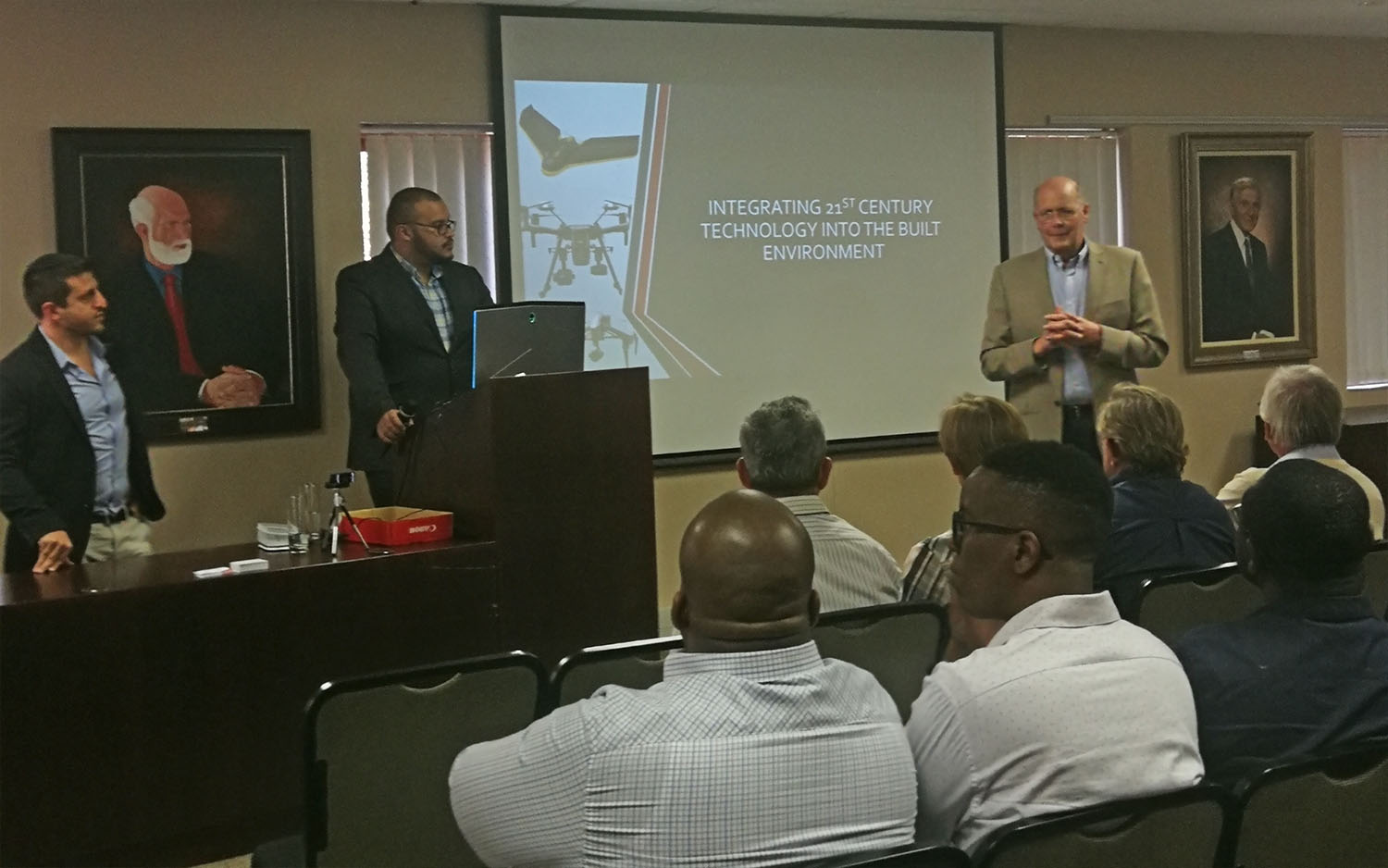
Drone Technology in Civil Engineering
4 September 2019
Drones are currently disrupting engineering workflows worldwide and rewriting the way things have been done in the past. The presentation covered the following:
- The development of drone technology
- How drones are currently being used for engineering applications
- The shift from pictures and video to high detailed 3D models
- Using drones in the design workflow
- Drones to BIM (Building Information Models)
- Using drones in the construction and project management workflow
- The new era of artificial intelligence and machine learning with drones
- Cases studies – locally and abroad
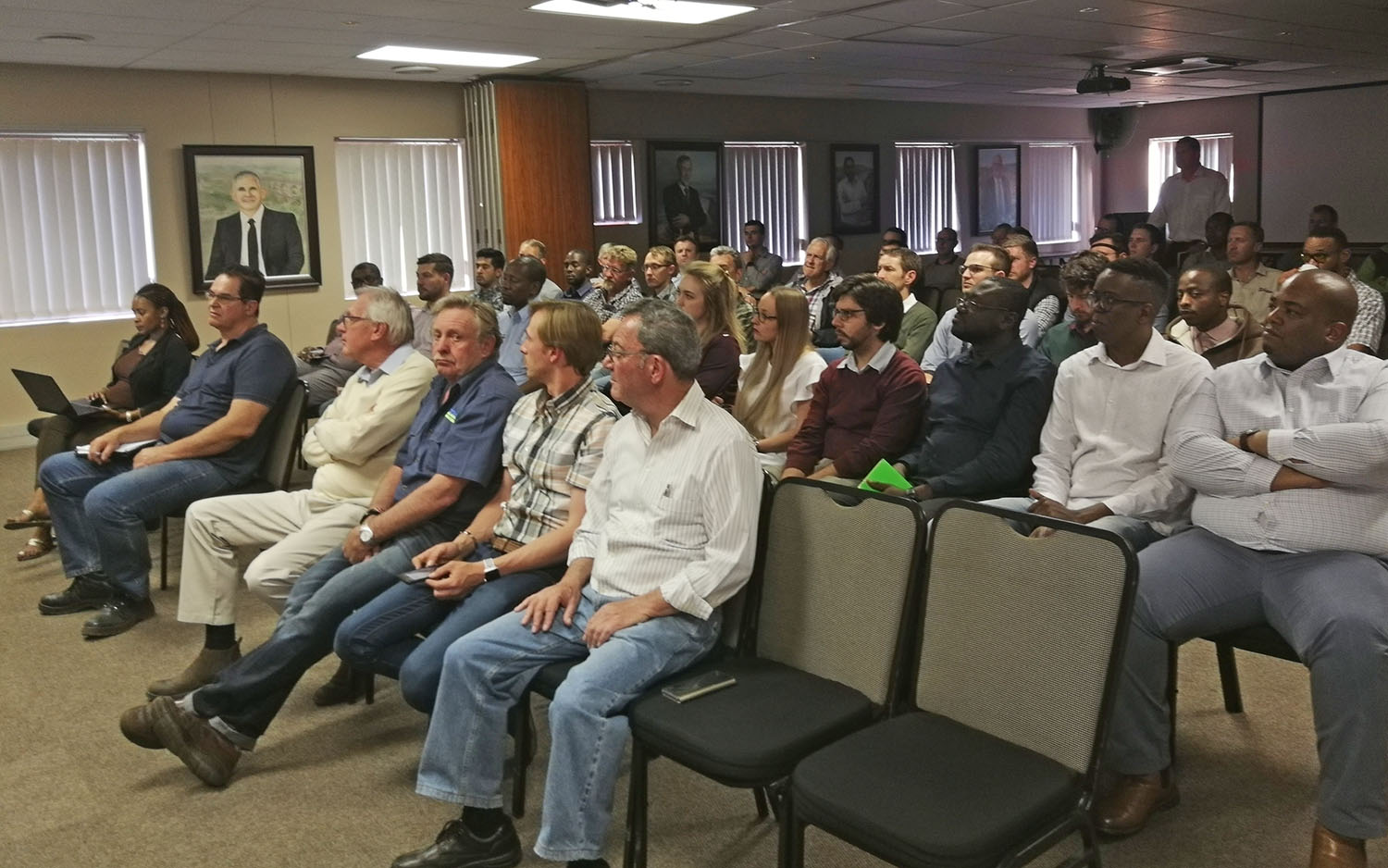
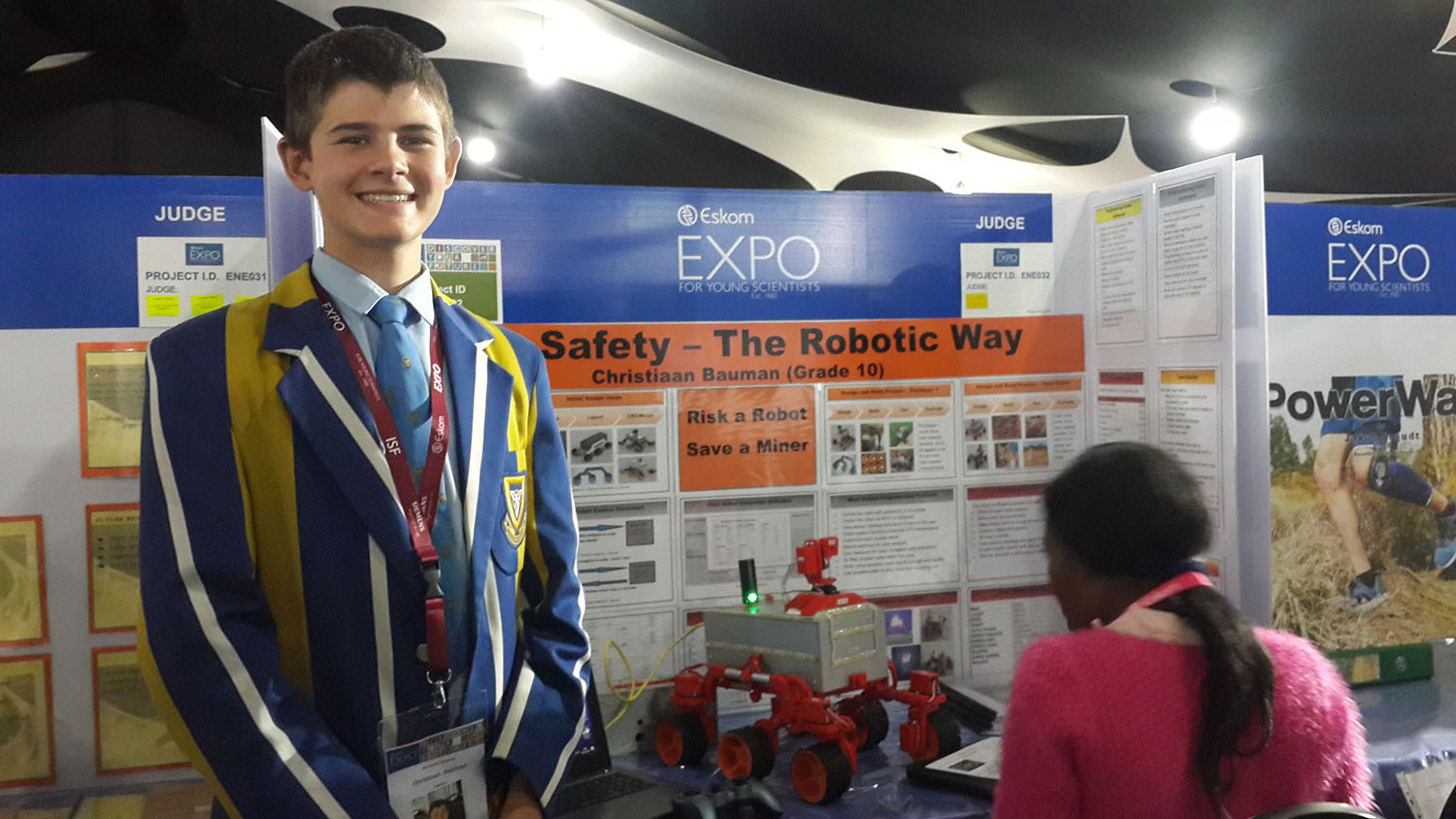
Eskom Expo for Young Scientists 2018
Christiaan Bauman of Hoerskool Waterkloof was awarded 1st prize in the Special Category of Information Technology at the Eskom Expo for Young Scientists 2018.
The Award was sponsored by SAICE-IT Division.